
By Dr. Seda Koçyiğit, oral and maxillofacial surgeon ·
The question patients ask most often once they decide on an implant is "How long will it take?" The short answer: placing the implant takes less than an hour, but the time until the permanent tooth is usually a few months. For most of that time, you carry on with daily life as normal.
In this article we explain how the process moves from one appointment to the next and how the timeline changes depending on your bone. For what an implant is, who it suits and the risks, see the Dental Implants page.
What sets the timeline: your bone
Two things determine the total time more than anything else:
- Whether there is enough bone. If bone is insufficient, it has to be built up first, and treatment takes longer.
- The time needed for the implant to bond with the bone. This depends on bone quality; it is usually shorter in the lower jaw and longer in the upper jaw.
This is why an exact timeline can only be given after an examination and a 3D CT scan. The scenarios below are meant to give you an idea.
The implant process, appointment by appointment
- First examination and CT scan. Your mouth is examined and your general health and medicines are discussed. A 3D CT scan is taken if needed. At this visit your treatment options, the estimated time and the cost become clear.
- Preparation (if needed). Any tooth that needs removing, gum inflammation or decay is treated first.
- Placing the implant. This is done under local anaesthesia. A single implant usually takes 30–60 minutes. You go home the same day.
- Stitch check. A check-up is usually done after 7–10 days and the stitches are removed.
- Healing period. There are a few short check-ups during this time. For gaps in visible areas, a temporary solution is planned, so you are not left without a tooth.
- Impression. Once healing is complete, an impression is taken with an intraoral scanner or the conventional method.
- Fitting the permanent tooth. The colour and fit are checked, and the permanent crown or bridge is fitted.
- Regular check-ups. After the permanent tooth, a check-up and professional cleaning at least once a year.
So in a straightforward case, treatment is usually completed in 5–7 appointments, including the first examination. Most of these are short check-ups.
Realistic timelines in three situations
Situation 1: Enough bone, tooth already removed
This is the most common and the shortest process.
- Week 1: Examination, CT scan and placing the implant (sometimes in the same week, sometimes on separate days)
- Week 2: Stitches removed
- 2–6 months: Healing period; usually shorter in the lower jaw and longer in the upper jaw, depending on bone quality
- Final week: Impression and fitting the permanent tooth
Total: usually 2–6 months.
Situation 2: The tooth still needs to be removed
There are two routes, depending on the condition of the tooth:
- Implant in the same session as the extraction: If there is no infection at the site and the bone is suitable, the implant can be placed on the same day as the extraction. The timeline is close to Situation 1.
- Extraction first, implant later: If there is infection or the bone is not suitable, the tooth is removed first and the site is left to heal. This usually takes a few months, after which the implant is placed and healing is awaited again.
Total: usually 3–6 months if the implant is placed in the same session; a few months longer with the staged plan.
Situation 3: Not enough bone, a sinus lift or bone graft is needed
If the sinus has dropped down at the back of the upper jaw, or bone has been lost in the jaw, bone is built up first.
- If the bone is only slightly insufficient: A sinus lift or bone graft can be done in the same session as the implant. Healing takes a little longer.
- If the bone is clearly insufficient: Bone is added first and a few months are allowed for new bone to form; then the implant is placed and healing is awaited again.
Total: usually 6–12 months with a staged plan, sometimes longer.
For patients missing all their teeth, the process is different: with All-on-4 and All-on-6, temporary fixed teeth can be fitted on the same day as the implants in suitable cases.
How much time off work or school will I need?
- The day the implant is placed: It is best to spend the day resting.
- The following days: Most patients who have a single implant return to desk work the next day. If several implants or bone grafting were done, 2–3 days of rest is more comfortable.
- Swelling: Usually greatest on day 2–3. If you have an important meeting, photo shoot or trip, it is a good idea to plan the procedure around it.
- Check-ups: Usually short, and can often be arranged outside working hours.
Coming to your first visit
To make the most of the appointment, it helps to bring:
- A list of all the medicines you take (especially blood thinners, diabetes medicines and osteoporosis medicines)
- Any previous X-rays or CT scans (if recent, a new scan may not be needed)
- Information about significant health conditions and past operations
- Any timing constraints: an upcoming trip, wedding or exam
Questions you can ask at the examination
- Is my bone sufficient, or do I need an additional procedure?
- How long will it take in total, and how many appointments will I need?
- Will I be without a tooth while it heals, and what will the temporary solution be?
- Which implant system will be used, and what kind of tooth will go on top?
- What does the total cost include?
- How often will check-ups be after the permanent tooth?
Things that slow down or put the process at risk
- Smoking: Slows healing and increases the risk of losing the implant. Stopping at least a week before the procedure and throughout healing is recommended.
- Missing check-ups: Small problems can grow if they are not noticed early.
- Putting pressure on the implant while it heals: Biting hard foods with the temporary tooth or on that side.
- Starting without treating gum disease: Increases the risk of inflammation around the implant.
- Uncontrolled diabetes: Slows healing; it is assessed with your doctor before treatment.
Frequently asked questions
Can an implant be done in one day?
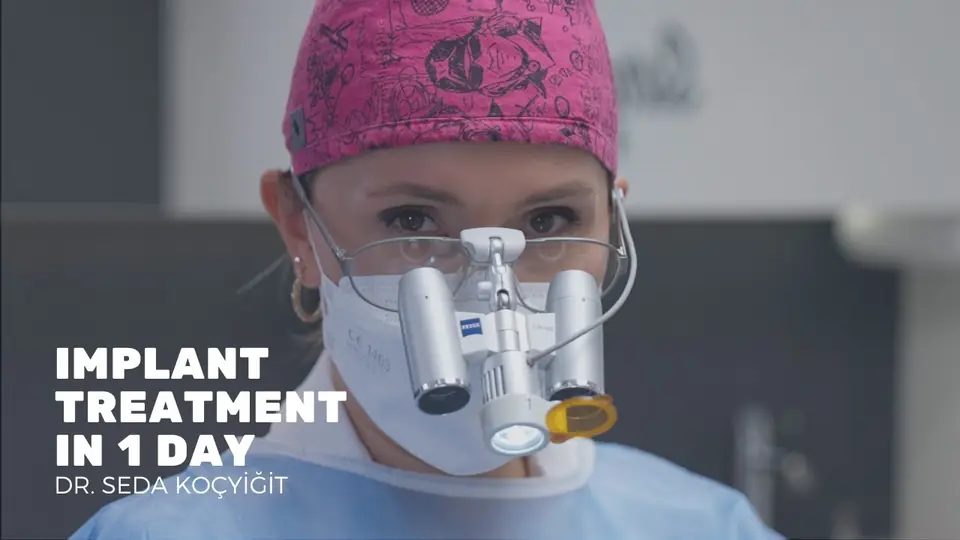
The implant is placed in one day. In suitable cases a temporary tooth can also be fitted the same day. The permanent tooth, however, is made after the implant has bonded with the bone, which usually takes a few months.
Can the healing time be shortened?
Healing is a biological process and varies from person to person. Pausing smoking, taking good care of your mouth, keeping general health conditions under control and attending check-ups help healing go smoothly.
I'm travelling from another city or country. How do I plan?
If the CT scan and initial assessment can be done in advance, placing the implant and the first check-up can fit into a visit of a few days. A second visit is needed after healing for the permanent tooth. The timeline is planned together based on your examination findings.
Can several implants be placed on the same day?
Yes, several implants can usually be placed in the same session. This reduces the total number of appointments. Whether it suits you depends on your bone and general health.
Let's talk through your questions at an examination
For an assessment of your own situation, message us on WhatsApp or call.
Our Treatments
Contact
Phone
+90 546 818 84 99
E-Mail
info@sedakocyigit.com